The Hiring Challenge Has Changed: Why Specialized Talent Matters More Than Ever

In today’s data-driven world, companies rely on more than raw numbers. They depend on people who can translate information into insight, strategy, and long-term value. At Jobsity, we believe the right talent is the differentiator, and understanding the distinction between data analysts and data scientists helps companies build the teams that drive clarity, speed, and smarter decision making. In this blog we break down these roles to help companies determine the talent they need in a rapidly evolving field.
Not long ago, the challenge for tech leaders was simple (and exhausting): find developers, any developers.
Today, that problem has evolved into something far more complex and far more urgent. Companies are no longer struggling to hire talent in general, they now struggle to hire the right talent. The kind that delivers immediate return on investment in an environment where speed, precision, and modernization are non-negotiable.
From AI initiatives to data engineering to legacy system modernization, the gap isn’t headcount. Its capability. And that gap is blocking progress.
From “Can We Hire?” to “Can We Modernize?”
Across industries, leadership teams are under pressure to modernize their technology stacks while continuing to deliver on core business goals. The ambition is there. The roadmap is there.
The skills? Not always.
Many organizations discover that their current teams, while talented and committed, aren’t equipped for the next phase of growth. AI adoption stalls, data pipelines become bottlenecks, legacy systems keep absorbing time, budget, and energy that should be going toward innovation. This mirrors the broader tech challenge of keeping up in the age of AI, where speed and expertise are essential to staying competitive.
The result is a painful paradox: knowing what needs to be done, but not being able to move fast enough to do it.
Why Traditional Hiring Is Failing the Moment
Local hiring has long been the default solution. But when it comes to specialized roles, it’s increasingly misaligned with business reality.
Here’s why:
1. Specialized talent is scarce and expensive locally
AI engineers, senior data specialists, and modernization experts are in high demand everywhere. Competing for that talent locally often means inflated salaries, long recruiting cycles, and no guarantee of fit.
2. Junior or generalist hires don’t solve urgent problems
Hiring a promising generalist or junior developer can work, eventually. That “eventually” usually comes after a 3–6 month ramp-up period, assuming strong mentorship and bandwidth that many teams simply don’t have.
When modernization is already overdue, waiting half a year for productivity isn’t a viable option. This reality is similar to what product teams face when racing to launch (balancing speed and quality) as we explore in how to bring products to market fast without sacrificing quality.
3. Time-to-impact now matters more than time-to-hire
The real cost isn’t how long it takes to fill the role—it’s how long it takes before that hire starts moving the needle.
In today’s environment, delayed impact equals delayed ROI.
The New Priority: Immediate, Specialized Impact
What tech leaders are really looking for now is not just talent, but ready-to-deliver expertise that gets results.
They need people who can:
- Step into complex systems without hand-holding
- Apply best practices from day one
- Solve problems they’ve already seen before
- Accelerate initiatives instead of slowing them down
This shift has fundamentally changed how successful companies approach hiring.
Instead of asking, “Who can we train?”
They’re asking, “Who can help us execute now?”
Nearshore Talent as a Strategic Advantage
This is where nearshore delivery has become more than a cost consideration, it’s a strategic enabler.
For US companies, tapping into experienced engineers across Latin America offers access to professionals who already specialize in areas like AI and LLM development, data engineering, and legacy modernization without the delays and constraints of local hiring. This is exactly the model Jobsity was built on.
The advantages go beyond talent availability:
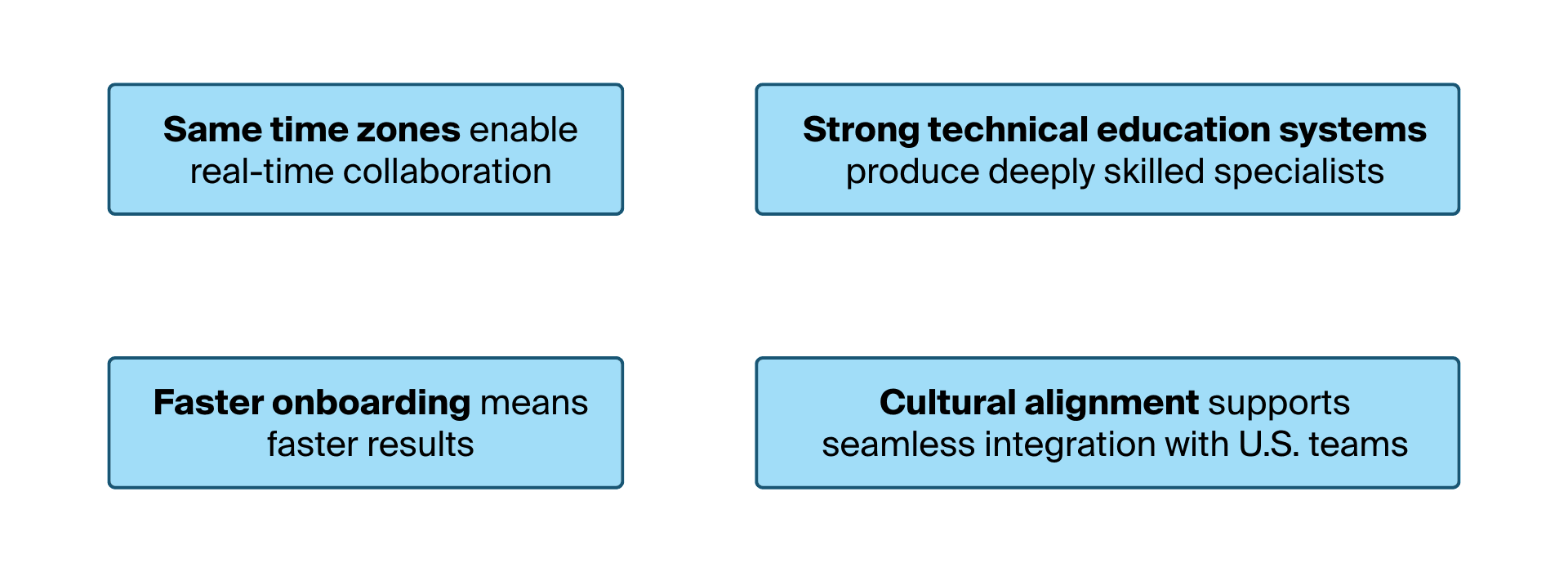
Instead of waiting months for a new hire to get up to speed, teams can bring in specialists who’ve already solved similar problems, and can do it again.
Closing the Skills Gap Without Slowing Down
The most successful organizations aren’t trying to solve every skills gap internally. They’re being selective and strategic.
They’re combining their core teams with external specialists who can:
- Modernize legacy systems without disrupting operations
- Build AI capabilities on solid data foundations
- Accelerate transformation initiatives with proven experience
This approach doesn’t replace internal teams, it unblocks them.
By removing the skills bottleneck, leaders free their teams to focus on innovation instead of firefighting.
The Bottom Line
The hiring challenge has changed, and hiring strategies must change with it.
In a world where modernization can’t wait, companies can’t afford long ramp-up times or trial-and-error hiring. They need expertise that delivers value immediately.
The question is no longer whether to access specialized talent.
It’s how fast you can put it to work.
And for organizations ready to move now, nearshore expertise is proving to be one of the fastest, most effective paths forward.
Does your company need specialized dev talent to drive results fast? Get handpicked candidates in a week.



Joey Rubin is a strategist, writer, and learning designer with experience in SaaS, education, and digital media. He specializes in transforming complex ideas into clear, engaging content that connects technology with people, bringing a focus on storytelling, clarity, and human-centered solutions.