How to Hire Nearshore Developers: The Complete Guide

You have a product roadmap to deliver, but the engineering role you need has been open for months. Qualified candidates are hard to find, and every week that passes puts more pressure on your team. Knowing how to hire nearshore developers gives you a faster way to close that gap.
Nearshore tech staffing gives you access to bilingual, U.S. time-zone-aligned Latin American developers. It expands your search beyond the domestic market while keeping the benefits of physical and cultural proximity. And tech staff augmentation can add that capacity to your existing team without requiring you to build an entirely new recruitment and HR operation.
But nearshore hiring shouldn't be a race to find the cheapest developer. The right partner helps you find people who can do the work and communicate with your team. They should fit your working style and stay long enough to create lasting value.
This guide walks you through what happens once you decide to explore nearshore hiring. It covers where to look, how to vet developers, and which engagement model fits. Then it shows how to get someone contributing without creating another layer of work for your team.
What It Means to Hire Nearshore Developers
Nearshore developers are software engineers who work from countries geographically close to your business, usually within a compatible time zone. For U.S. companies, that often means hiring developers across Latin America.
When your developers work during substantially overlapping business hours, you can run a standup in the morning and discuss a technical decision in real time. You can review work during the same afternoon, or resolve an issue before the day is over. Offshore engagements, which have to contend with major time-zone differences, can't offer that same rhythm.
Hiring nearshore developers can mean hiring one person as staff augmentation or bringing on a full team managed by your chosen partner. Either way, you expand your access to time-zone-aligned talent pools while reducing your recruitment and HR overhead.
Nearshore vs. Offshore: The Difference Is the Clock
Offshore and nearshore are sometimes treated as interchangeable terms, but they can create very different working experiences.
An offshore developer may begin their workday as your team is finishing theirs. Questions raised during your afternoon could sit unanswered until the next morning, and a code review can become an overnight handoff. A meeting may require someone to work outside their normal hours.
Nearshoring reduces that friction through time-zone alignment. For a product team, this can matter more than geographic distance itself. Software development depends on frequent feedback, collaboration, context sharing, and decisions that often cannot wait until tomorrow.
Nearshore developers can participate in the same meetings as your U.S. team, communicate directly with product and engineering leaders, and work within the same daily rhythm.
You can hire nearshore developers in several ways. You might add one or two developers directly into an existing engineering team or build a dedicated team around a particular product area. Another option is to hand an entire workstream to a managed development team. The right choice depends less on the number of developers you need and more on how much ownership you want to retain internally.
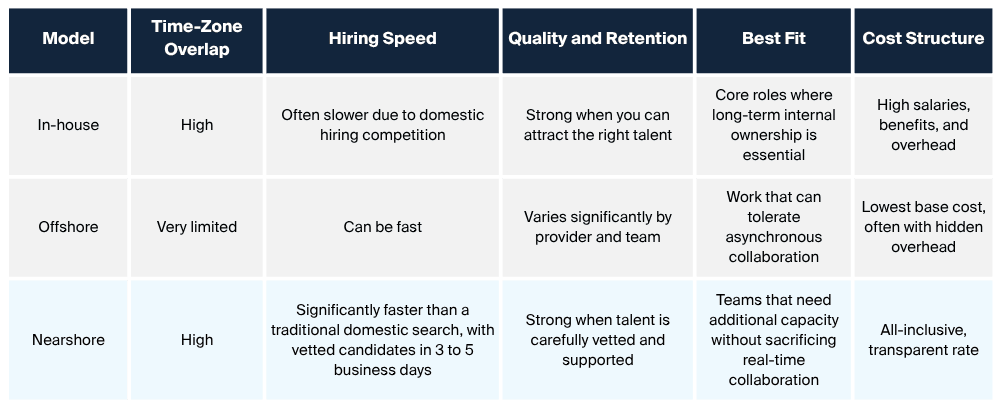
Nearshore vs. Offshore vs. In-House
If you're considering nearshore hiring, you're probably comparing it with two alternatives: hiring another U.S.-based employee or building an offshore team. Deloitte's Global Outsourcing Survey found that skilled talent and agility now join cost reduction as key drivers for outsourcing.
Each model can work, and our comparison of onshore, offshore, and nearshore hiring covers each one in more depth. The question is which one gives you the right combination of speed, quality, collaboration, and long-term fit for the work ahead.
In-House Hiring
Hiring a U.S.-based developer gives you maximum proximity to your existing organization. The developer becomes a direct employee, working within your internal systems and growing within your company over time.
The challenge is access. When a role requires a specific combination of technical experience and communication skills, your candidate pool can shrink fast. According to the U.S. Bureau of Labor Statistics, software developer employment is projected to grow 10% from 2025 to 2035, well above the average for all occupations. That tight market only sharpens the access problem.
For companies with a pressing roadmap, waiting for the right in-house hire may not fit your business timeline.
Offshore Hiring
Offshore development can expand your access to global technical talent, but distance can introduce operational challenges. A significant time-zone difference can make synchronous collaboration difficult, with feedback cycles, meetings, and small questions all taking longer to resolve.
That doesn't make offshore ineffective. It simply fits best when your team's work can run on a more asynchronous cadence.
Nearshore Hiring
Nearshore development is at the intersection of the other two models, expanding your talent pool beyond the U.S. while maintaining substantial overlap with your team's working hours. Nearshore adds capacity without the asynchronous friction of offshore teams.
Nearshore can provide meaningful savings over the fully loaded cost of U.S. hiring. It reduces the recruitment, HR, and overhead expenses that come with a domestic hire. Cost belongs in the decision, but it shouldn't be the only factor.
The real question is: Which model gives you the engineering capacity you need, with the least operational compromise?
What Influences the Cost of Hiring Nearshore Developers
The cost of hiring nearshore developers varies based on the role, technical requirements, engagement model, location, seniority, scope, and length of the engagement. Rather than a universal rate, evaluate the factors that determine total cost.
- Seniority and experience: A senior engineer will generally require a different investment than an entry-level developer. A more experienced developer can make architectural decisions, identify risks earlier, and contribute without extensive oversight.
- Technical specialization: The more specialized the skill set, the more constrained the talent pool may be. A role requiring cloud infrastructure, data engineering, cybersecurity, AI, or a particular framework is harder to fill.
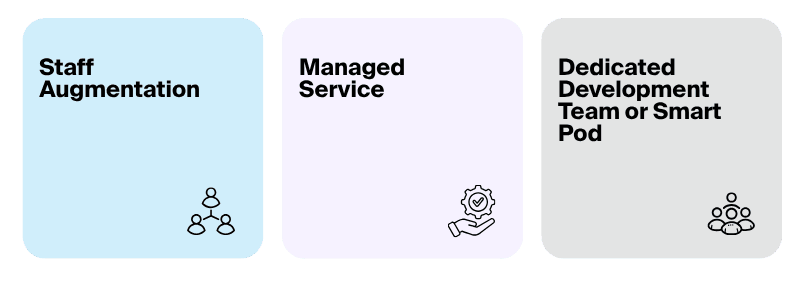
- Engagement model: Staff augmentation, a managed service, and a dedicated development team or smart pod each offer different levels of service. The model determines who is responsible for recruitment, HR, payroll, equipment, and upskilling.
- Scope and length: A short-term project and a long-term product team create different requirements. Filling a temporary gap calls for flexibility above all, while a product that evolves for years depends on retention, institutional knowledge, and stability.
- Collaboration requirements: A role that requires daily interaction with your U.S. engineering team benefits substantially from time-zone alignment. Sprint planning, pairing with another engineer, and responding to production issues all depend on shared hours.
- Location: Latin America isn't one homogeneous talent market. Countries differ in technical skillsets, education systems, knowledge of U.S. business culture, and English proficiency. Where a developer is based can shape both the talent available for your role and the investment it requires.
Look Beyond the Rate
The number attached to a developer is only one part of the equation. Onboarding time, recruitment effort, HR administration, equipment, management overhead, and retention all belong in the calculation.
A developer who leaves after a few months creates another recruitment cycle and another loss of product context. A partner-managed model absorbs those responsibilities instead of leaving them with your internal team.
The goal is to understand the fully loaded picture and determine whether the model delivers the quality and capacity your roadmap requires.
Where to Hire Nearshore Developers: LATAM Talent Hubs
The country you recruit from can influence time-zone alignment, English proficiency, cultural proximity, and talent pool size, and that pool is expanding quickly. GitHub's 2025 Octoverse report recorded 3.2 million net-new developers across Latin America (LATAM) between 2024 and 2025, with Brazil, Mexico, and Colombia as standout markets.
Georgetown's Center for Security and Emerging Technology (CSET) found a similar trend upstream. STEM graduates in Brazil and Mexico grew roughly 26% and 30% between 2015 and 2020. Four markets are particularly relevant for U.S. technology buyers:
- Colombia: The country has become a major technology hub, and its developers can work closely with teams across Eastern, Central, and Mountain schedules. Jobsity recruits there based on client requirements rather than a single talent pool.
- Argentina: Argentina's long-established ecosystem has a deep bench of engineers across web development, cloud, and data. Jobsity draws on that market when a role calls for senior-level technical experience.
- Brazil: The country is the largest technology market in the region, with strong overlap with Eastern and Central business hours. That scale makes recruitment quality critical, so Jobsity matches candidates to each role's specific requirements.
- Mexico: Mexico's proximity to the United States makes it a natural nearshore market for close time-zone alignment. Its growing technology ecosystem produces software engineering talent across a range of modern stacks.
English proficiency varies more than many buyers expect. In the EF English Proficiency Index 2025, Argentina ranks 26th of 123 countries and sits in the high proficiency band. Brazil, Colombia, and Mexico score below the global average. National averages say little about an individual engineer, though, which is why a strong partner tests fluency candidate by candidate.
The best country is the one where your partner can consistently find the skills, communication ability, and experience your role requires. The largest talent pool doesn't guarantee that.
How to Hire Nearshore Developers, Step by Step
If you're trying to understand how to hire nearshore developers, treat the process like any other important technology hiring decision. Define what you need, validate that need with a qualified partner, evaluate specific engineers, and get the right person integrated into your team.
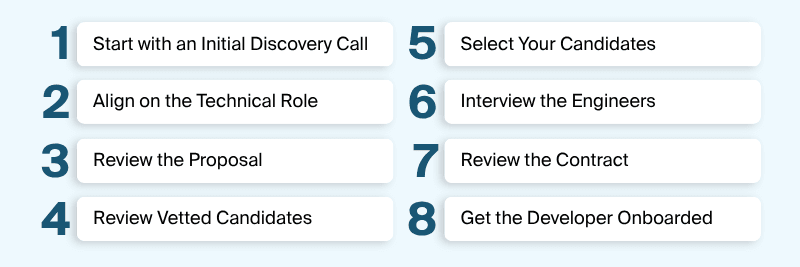
At Jobsity, the process is organized into two phases: discovery and alignment, followed by role fulfillment and onboarding.
Step 1: Start with an Initial Discovery Call
Steps one to three are part of the first phase. The first conversation should be short and practical. You explain what you're trying to accomplish, why you're hiring, what your current team looks like, and where you're experiencing a capacity or capability gap.
A good partner should use this conversation to determine whether nearshore hiring is appropriate for your situation, and whether their model can realistically solve it.
Step 2: Align on the Technical Role
Once there's a fit, the next conversation should get much more specific. Jobsity uses a 30- to 45-minute technical discovery call to understand your technology environment and define the role. On that call, you should discuss:
- Your technology stack
- The developer's day-to-day responsibilities
- Required seniority
- Team structure
- Existing workflows
- Communication expectations
- The problems the developer needs to solve
- Definition of success
This step matters because "senior developer" isn't a complete job specification. Two companies can use the same title for completely different roles. One company might need someone to build new product functionality, while another might need an engineer to modernize a legacy codebase. A clearly defined role gives your partner a precise target, so the candidates you see fit the actual work.
Step 3: Review the Proposal
Following the technical discovery call, you receive a detailed proposal outlining the scope and proposed team. Jobsity typically provides the proposal within two to three business days of the technical call.
The proposal should give you enough information to answer one basic question: Does this team structure make sense for the work you need done?
Step 4: Review Vetted Candidates
Steps four to eight make up the second phase. Once the role is defined, the partner begins sourcing and vetting candidates.
Technical ability is only one part of that evaluation. Jobsity evaluates candidates across technical skills, soft skills, English fluency, and cultural fit before presenting them to clients. The objective is a curated short list rather than a high-volume resume dump, saving your company the time of screening candidates who were never a realistic fit.
Jobsity typically presents vetted candidates within three to five business days.
Step 5: Select Your Candidates
You review the short list and identify the candidates you want to meet. That choice is an important distinction between partner-led recruitment and simply searching a marketplace.
The partner should do the initial qualification, but you keep meaningful control over who joins your team.
Step 6: Interview the Engineers
You decide whom you want to interview, and the partner handles scheduling and follow-ups. That lets your engineering leaders focus on the actual evaluation rather than coordinating calendars and chasing candidates.
The interview should focus on the work the person will actually do. Ask about technical decisions they've made, and give them realistic scenarios to see how they explain their thinking.
Whenever possible, interview the specific engineer who will join your team rather than a representative from the provider.
Step 7: Review the Contract
Once you've selected a candidate, your legal and HR teams review the contract and make any necessary changes. A strong partner should have a defined process for handling those changes rather than treating the contract as an afterthought.
The contract review is where you and your partner clarify responsibilities around intellectual property, confidentiality, security, equipment, and performance. It should set the conditions for changing or ending the engagement.
Step 8: Get the Developer Onboarded
The final step is getting the developer ready to contribute. This includes equipment setup, signed contracts, access to the required systems, and an onboarding call.
Jobsity typically aims to complete this process within about a week.
Your internal team should already know what the developer is joining before day one. The codebase, tools, documentation, sprint structure, communication channels, and immediate priorities should be ready.
The result is a productive developer contributing in weeks, not months, while the partner absorbs the recruitment, HR, payroll, and equipment work your team would otherwise carry.
How to Vet Nearshore Developers Before You Hire
The quality of your nearshore team depends heavily on what happens before you ever make an offer. A polished resume isn't enough. You need to evaluate the person across three dimensions: technical capability, communication, and security.
Technical Skill
Start with role-specific evaluation. If you're hiring a backend engineer, test backend engineering skills directly. If you're hiring a data engineer, test the skills required for your data environment.
Ask candidates to walk through real projects they've worked on and give them opportunities to explain technical decisions rather than relying entirely on theoretical questions. Where possible, review a work sample or code the candidate can share, since it shows how they structure and document their work.
Live technical interviews can reveal how someone approaches unfamiliar problems, communicates tradeoffs, and responds to feedback. The goal is a specific person who can do this specific job well.
Communication and English Fluency
English fluency should be evaluated live during the interview process. The developer needs to be able to explain technical concepts, ask clarifying questions, communicate blockers, participate in meetings, and adapt their communication to technical and nontechnical stakeholders.
Ask yourself whether you could comfortably work with this person every day. If your team relies on daily standups, sprint planning, code reviews, and frequent Slack conversations, then communication is a core engineering skill.
Test time-zone overlap against your actual schedule. "Nearshore" isn't useful if the developer's working hours don't overlap with the people they need to collaborate with.
Security and Intellectual Property
Make security part of your evaluation before the developer ever has access to your systems. Ask how the partner handles confidentiality, data access, intellectual property, equipment, and employee offboarding.
You should understand whether appropriate NDAs are in place and how sensitive data is handled. Confirm that your company owns intellectual property from the moment it's created. A serious nearshore partner should be able to explain its security and IP processes clearly.
Retention Connects Everything
Technical skill, communication, and security matter at the beginning of the relationship. Retention determines how much of that value you keep and how much you gain over the long term. Jobsity reports an average developer retention of three years.
That matters because long-term developers accumulate context. They understand your architecture, know your product decisions, and build relationships with your internal team. They become faster because they adapt to how your organization works and integrate themselves into the workflow.
When evaluating a partner, ask what makes a good developer stay, since retention is one of the clearest signals when choosing a nearshore partner.
Choosing an Engagement Model
Once you've decided to hire nearshore developers, you need to decide how they will work with your organization. The model you choose matters less than answering one question first: Who owns the backlog?
Staff Augmentation
With this model, vetted developers join your existing team directly, and you keep full control of how the work runs. You own the product roadmap, backlog, sprint planning, technical direction, and day-to-day management while the nearshore developer works as an extension of your team.
This can be a strong fit when you already have engineering leadership in place but need additional capacity. It allows you to start with as few as one or two developers and add developers as the roadmap requires. This is often the right starting point if you already have a VP of engineering or technical lead who wants to run point on the work.
Managed Service
A managed service model gives the partner greater responsibility for managing the work and the people involved. You still define the business objective, but the partner owns execution.
This can work well when you have a clear project or workstream but don't want your internal leaders responsible for every aspect of managing the external team. It fits well when the workstream sits outside your team's core expertise, and you'd rather lean on the partner's technical leadership than build it internally.
Dedicated Development Team or Smart Pod
A dedicated development team or smart pod is a managed group of engineers organized around a particular product, project, or workstream. This model makes sense when you're standing up a new product line or a workstream large enough to need its own backlog. You get a team structure with multiple roles rather than individual developers added one at a time.
The important thing is to match the engagement model to the operating model you already have. If your VP of engineering wants to own the backlog and manage the developers directly, staff augmentation may be the natural fit. If you want to hand off responsibility for an entire workstream, a managed or dedicated team might make more sense.
Red Flags to Avoid When Hiring Nearshore Developers
You don't have to approach nearshore hiring with suspicion, but you should ask good questions. The red flags usually become visible long before you sign anything.
- "Nearshore" without time-zone alignment: Ask where your developers will be located and what hours they'll work. A developer with only two or three overlapping hours isn't meaningfully different from an offshore hire, whatever the marketing says.
- Anonymous talent pools: A first name, a stock photo, or a generic skills list isn't enough to make a hiring decision. You should know exactly whom you're interviewing and be able to meet the engineer who will join your team.
- Bait-and-switch staffing: Ask whether the person you select is the person who joins your team, and under what circumstances the provider can substitute them. Any later change should come with total transparency.
- No clear security process: A partner should speak specifically to NDAs, intellectual property, equipment, access, and data handling. If the answers stay vague after follow-up questions, the process probably isn't worth relying on.
- No reasonable exit terms: Before you sign, understand how either side can change or end the engagement. A good partner explains its terms clearly from the beginning instead of leaving them to negotiate later.
- Large minimum commitments: Some providers require a sizable team before they'll start. Ask whether you can begin with one or two developers, prove the model, and scale from there.
- Placement-only relationships: If the provider's role ends once a developer starts, your team inherits HR, payroll, equipment, and retention. Ask who supports the developer after onboarding and how performance concerns are handled.
The goal is to find a provider that can answer difficult questions clearly and explain exactly how its operating model works.
Hiring Nearshore Developers in the Age of AI
The role of a software developer is changing quickly. AI-assisted development tools are becoming part of everyday engineering workflows, from code generation and debugging to documentation and research. The important question for a technology buyer is no longer whether a developer uses AI, but whether they know how to use it safely.
For a nearshore team specifically, this shift matters even more. When a developer works remotely without daily in-person oversight, unreliable AI-generated code can slip further before anyone catches it. The vetting process needs to confirm the developer applies the same judgment to AI output that they would to any other engineering decision.
The 2025 Stack Overflow Developer Survey found that 84% of developers now use or plan to use AI tools, up from 76% the year before. But more developers actively distrust the accuracy of AI tools (46%) than trust it (33%). Adoption is nearly universal, but confidence isn't. That gap is exactly why simple familiarity with AI is no longer enough.
You still need developers who understand the system they're working in and can evaluate generated code. They should recognize when an AI tool is wrong and make sound technical decisions when the answer isn't obvious. Human judgment matters even more now.
When evaluating an AI-fluent nearshore developer, ask these questions:
- Which AI development tools do you use?
- What types of tasks do you delegate to AI?
- How do you validate generated code?
- When would you avoid using AI?
- How do you protect proprietary or sensitive information?
- Can you explain a technical decision without relying on the tool?
These questions fit naturally into the technical portion of your vetting process, alongside the live technical interviews covered earlier in this guide.
A strong modern developer should be able to use AI to accelerate their work without outsourcing their judgment to it. For buyers, that means the hiring bar should become more focused on the developer's ability to reason, verify, communicate, and build responsibly. The developers worth hiring can explain what AI produced and why they trusted it, adjusted it, or rejected it outright.
Onboarding Your Nearshore Developers for the Long Run
Hiring the right developer is only the beginning. The onboarding process determines how quickly that person becomes productive and how effectively they integrate with your existing team. Six habits make the biggest difference in the first weeks.
- Before day one: Set the developer up with equipment, accounts, repository access, documentation, and a clear view of the first sprint. Shared hours let you run onboarding live instead of relying on written instructions.
- The first week: Introduce the developer to the people they'll work with most, explain how your team communicates, and show them where decisions are documented. Make expectations around meetings, code reviews, and working hours explicit.
- The first assignment: Assign meaningful work quickly. The first task doesn't have to be strategically important, but it should help the developer learn your codebase, processes, and quality standards.
- Check in often, early on: Meet more often than you would with an internal hire in the first few weeks. Early feedback closes context gaps faster and helps the developer calibrate sooner.
- A named point of contact: Pair the developer with a technical lead or teammate during the first few weeks. That person can answer questions about the codebase, tools, and team norms.
- Clear early milestones: Agree on what success looks like for the first month, such as a first merged pull request or a small feature they own. Shared expectations make early check-ins more productive.
Beyond Engineering
A strong partner can manage the parts of the lifecycle that happen outside engineering, including HR, payroll, equipment, and upskilling. That matters because a nearshore developer shouldn't feel like an external resource who happens to write code for your company. They should feel like part of the team.
When the partner carries that administrative load, staff augmentation and your HR team stop competing for the same hours.
Why Companies Partner with Jobsity to Hire Nearshore Developers
The value of a nearshore partner is the ability to build and maintain a team without extra strain on your leaders. Your engineering and HR teams should not have to manage every part of the talent lifecycle themselves. This goes well beyond simple access to talent.
Jobsity has been a nearshore talent partner for 14 years, with roughly 500 team members and a major recruitment footprint across Latin America.
Its engineers are 100% bilingual, allowing them to work directly with U.S. teams and communicate comfortably in English. Jobsity reports a three-year average developer retention rate, giving clients the opportunity to build teams around people who develop meaningful knowledge of their products over time.
That long-term relationship is important. The best nearshore team is a stable group of engineers who understand your product, your technical environment, your processes, and the people they work with.
Jobsity's track record includes a 4.8 rating on Clutch and long-term, successful relationships with clients such as McGraw-Hill.
What is more important is how the partnership works day to day. Jobsity supports the talent lifecycle from recruitment through onboarding and upskilling, while handling responsibilities including HR, payroll, and equipment.
Jobsity's level of service gives you a single partner for building engineering capacity instead of coordinating separate vendors for recruitment, employment administration, and development support. The result is a nearshore model built around four things:
- Stable LATAM teams: Developers stay long enough to build deep knowledge of your product.
- Strong cultural fit: Engineers are evaluated on how they communicate and collaborate as well as on what appears on their resume.
- Transparent pricing: You get a clear understanding of what the engagement includes.
- Low-risk onboarding: A defined process covers everything from candidate selection through equipment, contracts, and day-one readiness.
For a technology leader, that means more time managing the roadmap. You spend less time on the mechanics of finding and supporting every person required to deliver it.
Frequently Asked Questions
A few questions come up in almost every conversation about hiring nearshore developers. Here's what technology leaders most often want to know before they get started.
How is hiring nearshore developers different from using freelancers?
The primary difference is the level of support around the developer. Freelancers usually operate as individual contractors, while a nearshore partner can handle recruitment, vetting, HR, payroll, equipment, and ongoing support. That gives you access to an individual developer while reducing the administrative work required to manage the relationship, with greater continuity for a long-term engineering team.
How many developers can I start with?
Jobsity's staff augmentation model can begin with one or two developers, allowing you to add capacity without committing to a large team immediately. Starting with a small group gives your organization an opportunity to establish working rhythms, communication patterns, and expectations before expanding the team. From there, most teams add developers gradually as the roadmap grows, rather than negotiating an entirely new engagement each time capacity needs change.
What happens if a nearshore developer is not the right fit?
A good partner should have a defined process for addressing a mismatch. Find out how performance concerns are handled, who manages the conversation, and what happens if the developer needs to be replaced. You should understand the process before hiring, rather than trying to establish it after a problem occurs. Ask specifically how replacement timelines and any associated costs are handled, since those details matter most during a real transition.
How much time-zone overlap will I get with Latin American developers?
The amount of overlap depends on the country and your team's working hours, but many Latin American markets provide substantial alignment with U.S. business hours. When evaluating candidates, confirm their actual working schedule rather than assuming geographic proximity guarantees the overlap you need. Colombia and Mexico line up closely with U.S. Eastern and Central time. Argentina and Brazil run one to two hours ahead of Eastern time, which matters more if your team works on Pacific time.
Do nearshore developers speak fluent English?
English proficiency varies by individual, so it should be evaluated during the hiring process. Jobsity's engineers are 100% bilingual, and candidates are evaluated for communication and English fluency before being presented to clients. You should still interview the specific developer who will join your team and assess how comfortably they communicate in the situations your role requires. Fluency in a live conversation is a better test than fluency on paper, since day-to-day collaboration depends on thinking and responding in English in real time.
Can I scale my nearshore team up or down as needs change?
You can scale a nearshore team up or down as your needs change. Add individual developers when a project requires additional capacity, or build a larger dedicated team around a defined workstream. Before signing, clarify how changes to team size are handled and what notice is required. That flexibility is one of the clearest advantages nearshore has over a purely in-house team, where scaling down usually means layoffs rather than simply adjusting an engagement.
Nearshore developers can work within the same development environment as your internal engineers, including your code repositories, project management tools, communication platforms, CI/CD workflows, and documentation systems. During onboarding, establish access requirements and working conventions before the developer starts so that they can participate in your existing processes from the beginning. There's no separate toolkit or workaround required. The goal is for a nearshore developer's day-to-day experience to look identical to that of a developer sitting down the hall.
How does developer retention work with a nearshore partner?
Retention depends on the developer experience, quality of the work, compensation, management, career development, and the support provided by the partner. Jobsity's developers stay for an average of three years. When evaluating a partner, ask for its retention record and understand what it does to keep strong developers engaged over time. That tenure matters because long-term developers accumulate product knowledge that a high-turnover partner can't offer, no matter how strong its vetting.
Which industries most often hire nearshore developers?
Nearshore developers can support a wide range of technology organizations and industries. The model is particularly useful when a company has a defined engineering need but faces difficulty finding the required technical skills domestically. What matters more than your industry is whether your engineering needs are specific enough that a generic talent pool won't cut it. Your partner needs to source developers with that specific technical and industry experience.
How do I measure whether a nearshore hire is working?
Measure the developer against the same outcomes you would use for an internal engineer. Depending on the role, that could include delivery against sprint commitments, code quality, incident resolution, technical contributions, communication, and progress against product milestones. Track longer-term indicators such as retention and how much product or system knowledge the developer builds over time. Hold a nearshore hire to the same bar as every engineer on your team, even though they're not sitting in your office.
Key Takeaways for Your Engineering Roadmap
Nearshore hiring gives you access to engineering talent without asking you to choose between quality and proximity.
- The right process reduces the risk. Define the role carefully, evaluate technical ability and communication, and interview the actual developer. Then choose an engagement model that matches how your team operates, and make onboarding part of the hiring strategy.
- The right partner handles more than recruitment. The strongest nearshore relationships support the full talent lifecycle, from sourcing and vetting through HR, payroll, equipment, onboarding, and upskilling.
- The right team becomes part of your organization. Time-zone alignment makes collaboration easier. Strong retention lets developers build the product knowledge and relationships that make them part of the team rather than a disconnected part of the organizational chart.
If you're evaluating how to hire nearshore developers, the goal is to add the engineering capacity your roadmap requires. The right people can work effectively alongside the team you already have.
Build Your Nearshore Team with Jobsity

You don't have to figure out the right hiring model, talent market, and team structure on your own.
Talk with the Jobsity team about the engineering capacity you're trying to build, the roles you're struggling to fill, and the way your existing team works. We'll help you determine whether nearshore is the right fit and what the next step should look like.



Jenna has a diverse professional background, including over 20 years of human services and mental health experience. She’s qualified as an LPC (Licensed Professional Counselor). Over the last 7+ years, she’s built her career working in consulting and business development, helping IT leaders scale their teams efficiently and affordably. As a leader of global teams, she knows first hand how to maximize the potential in a distributed team model. Her goal is to support individuals and teams in surpassing their goals to become the best versions of themselves.