Staff Augmentation vs Managed Services: How to Choose

When your roadmap outpaces your team’s capacity, it can show up as a product backlog that keeps growing no matter how many sprints you add, or a support queue that stays red through every staffing change. At some point, every technology leader runs into the same question: do you add to the people you direct, or hand the whole function to a provider who owns the result? That choice is the tech staff augmentation vs managed service question, and choosing well matters more than choosing fast.
Both models extend what your team can do, which is why they are so often confused. But they solve different problems. With staff augmentation, vetted developers join your team and take direction from your managers, the way your in-house team does. With a managed service, a provider runs an entire function, such as a customer support operation, and answers for the outcome against agreed-upon targets.
The short version: staff augmentation adds team members you direct, and you own the outcome. A managed service hands a function to a provider who owns the results.
This guide walks you through the difference in plain terms, gives you a side-by-side comparison, and ends with a tool to help you pick the model that fits. One note before we start: the question we’re answering here is about fit and function, not finding the cheapest option.
Staff Augmentation vs Managed Services: The Short Answer
Two questions define the model.
First: who directs the day-to-day work?
In staff augmentation, your managers do. The added team members sit in your standups, work in your tools, and take priorities from your leads.
With managed service, the provider's managers do, using a process they own.
Second: who is accountable if the result is missed?
In staff augmentation, you are. You chose the priorities, so you own the result.
With a managed service, the provider is, and that accountability is often written into the contract as targets the provider commits to meet.
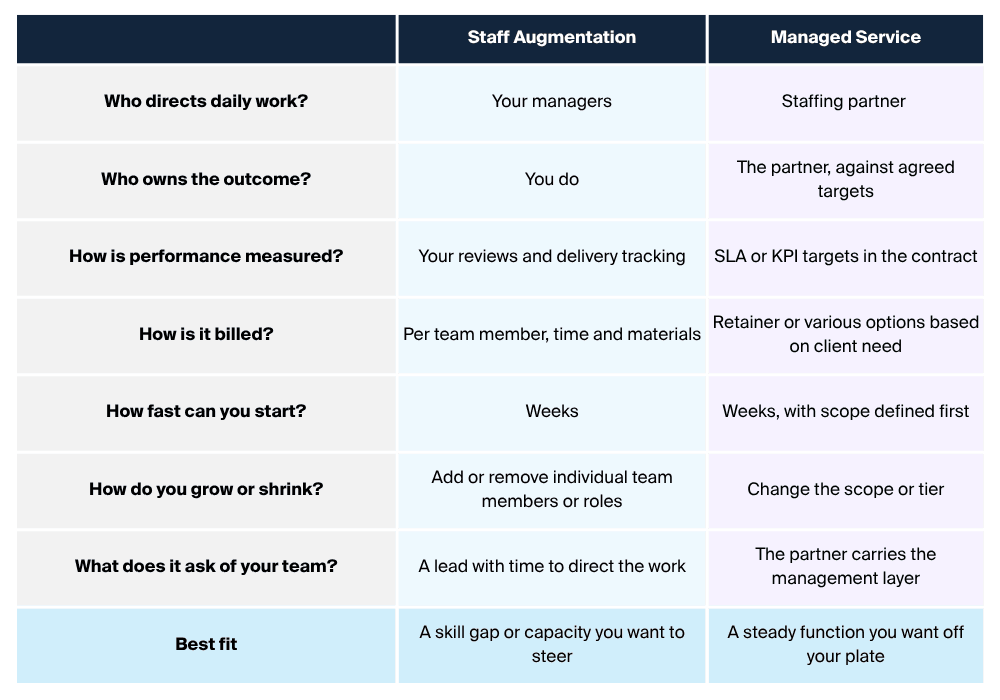
Everything else—billing, speed, how each model grows or shrinks—follows from those two answers. The side-by-side comparison below puts the two models next to each other across the eight questions buyers ask most.
One thing to call out now: many teams end up using both; a developer or two on the engineering side and a provider-run support desk on the customer side. We cover how that works in the hybrid section toward the end.
What Is Staff Augmentation?
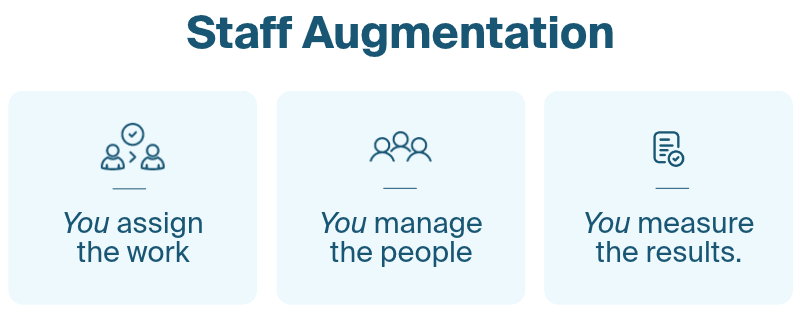
Staff augmentation adds vetted team members to your existing team. They work in your tools, join your sprints, and take direction from your managers, just like your in-house staff. You own the priorities and set the standard their work has to meet.
The model is different from hiring freelancers, and the difference is the staffing partner. A staff augmentation partner handles the work that surrounds the job: recruiting and vetting candidates, contracts, HR, payroll, equipment, and replacing a team member who is not working out. You make one decision—what kind of person you need—and the partner carries the administration that would otherwise land on your HR and finance teams.
That structure is what makes the model fast and flexible. You can start with one or two developers and add more when the work grows, without running a hiring process each time and with the option to evolve roles as needed.
The trade-off is real: staff augmentation needs a lead with time to direct the work. The team members are yours to steer. If nobody on your side has the capacity to assign work, review it, and keep priorities current, the model isn’t for you. That constraint is one of the clearest signals in the decision later in this guide.
What Is a Managed Service?
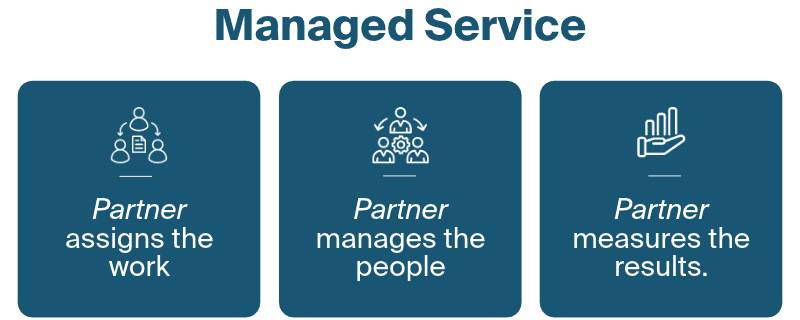
A managed service hands an entire function to a provider who owns the outcome. The provider brings its own managers, its own process, and its own team, and commits in the contract to agreed targets, usually a service level agreement (SLA) or key performance indicator (KPI) targets for quality, speed, or coverage.
Two examples:
On the technology side, a company can hand a software delivery workstream to a provider; the provider assembles the team, runs the delivery process, and reports against the agreed milestones. On the customer experience side, a company can hand its customer support operation to a provider; the provider runs the contact center, manages the agents, and answers for response times and quality scores.
What changes for you is where your attention goes. You give up some day-to-day control, you are not assigning tasks or managing individuals, and decisions about how the work gets done sit with the provider. In exchange, accountability moves to the provider. If service levels slip, that’s the provider's problem to fix, and the contract is what makes that more than a promise.
Staff Augmentation vs Managed Services: Side-by-Side Comparison
Here are the two models next to each other and the questions buyers ask most. The three rows below the table are the ones you should take most seriously.
Control
Staff augmentation keeps control where it already lives: with you. Your leads decide what gets built, in what order, and to what standard, and they can change any of it whenever they want. That is the point of the model, but it also shows the dependency, since the steering has to come from someone.
A managed service trades that control for coverage. You set the goals and the targets, and the provider decides the how. For a settled, well-understood function, most leaders find the loss of day-to-day control costs little. For work where the direction itself is still being figured out, it can cost a lot.
Accountability
In staff augmentation, accountability stays in your building. The team members report through your management structure, and a missed sprint is your sprint to fix. In a managed service, accountability transfers, and the transfer is the contract: targets, response times, quality thresholds, and what happens when they are missed.
Neither arrangement is safer. The question is which one you are equipped to carry. Accountability you can actively manage is an asset; accountability you cannot staff for is a liability.
Performance measurement
With added team members, you measure the way you already measure your in-house team: code review quality, sprint velocity, delivery against the roadmap. With a managed service, measurement is defined before the work starts, in the SLA or KPI targets, and the provider reports against them on a set rhythm.
The second way is more disciplined and less work for you. The first is more adaptable to work whose definition of success may be a moving target.
Who Directs the Work and Who Owns the Result
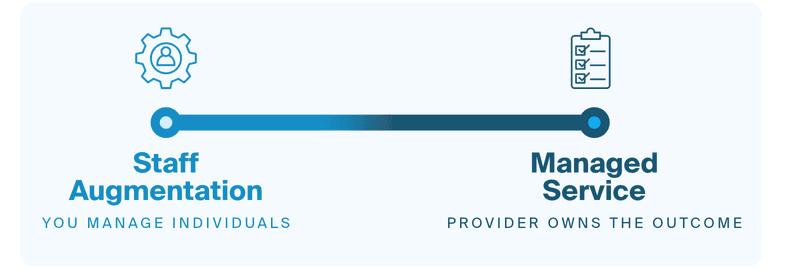
Put every arrangement on one spectrum and the choice gets simpler. On one end, you manage individuals: staff augmentation, where the people are yours to direct and the outcome is yours to own. On the other end, the provider owns the outcome: a managed service, where the function runs to a target and the steering happens inside the provider.
Here’s a short example of each.
A fintech company adding a senior backend developer for six months to accelerate a payments migration wants that developer in their standups and their pull request queue. They need staff augmentation.
A retail company that wants its order-support inbox answered within two hours, around the clock, without building a contact center. They need a managed service.A healthtech firm building out a new product area needs a managed, cross-functional team to operate with minimal oversight and deliver on an organizational initiative. They need a Smart Pod, which is a type of IT staffing managed service. A Smart Pod offers a dedicated cross-functional squad of multidisciplinary, senior specialists to provide managed product engineering capacity.
The rule of thumb: the more you want to steer the work yourself, the closer you should be to staff augmentation. The more you want a result without steering, the closer you should be to managed service.
How Cost Works in Each Model
The billing structures differ, and the difference mirrors the control difference.
Staff augmentation is billed per team member. You pay for the people and the hours, and you can add or remove team members as the work changes. The advantage is transparency: you can see exactly what capacity costs, and you only carry the capacity you use.
A managed service is billed as a retainer or with a flexible billing model, depending on your needs. You pay for the function to run at an agreed level, whether that is per minute, per interaction, per agent or per productive hour, and the provider absorbs the variability underneath: staffing, management, process, and tooling. The advantage is the cost tracks to the commitment, not the headcount.
Beyond the rate, both models carry costs that deserve comparison. In staff augmentation, the biggest hidden cost is your management time, and the second biggest is turnover. When a team member leaves, the knowledge leaves with them until a replacement ramps up. In a managed service, the costs that surprise people are change requests outside the agreed scope, which are priced separately.
Retention is where a good partner changes the math. Jobsity's developers stay an average of three years, and its support agents average 95% retention, so the ramp-up and knowledge-loss costs that usually ride along with added teams stay low. Plus the hiring itself has lower cost: clients save up to 40% on hiring costs with Jobsity's tech staffing.
For specific rates, talk with the Jobsity team: pricing depends on the skills, the seniority, and the engagement; there is no set fee structure but dynamic rates customized to your needs.
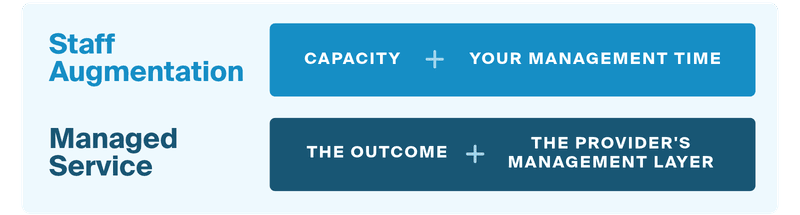
When Staff Augmentation Is the Right Fit
Staff augmentation tends to be the right call when most of these are true:
- You have a lead with time to direct the added team members.
- Requirements are still changing week to week, so the direction itself needs to stay with you.
- You need a specific skill or extra capacity, not a whole function.
- You want the work close: in your tools, your rituals, and your line of sight.
- You may need to scale up or down as the roadmap shifts.
It’s the model for teams that know where they are going and need more hands that can be steered on the way. With Jobsity, you can start with as few as one or two developers, vetted and bilingual, working in U.S. time zones, which makes directing them feel like directing anyone else on your team.
If you are weighing this route, the benefits of staff augmentation page goes deeper on what the model does for an IT team.
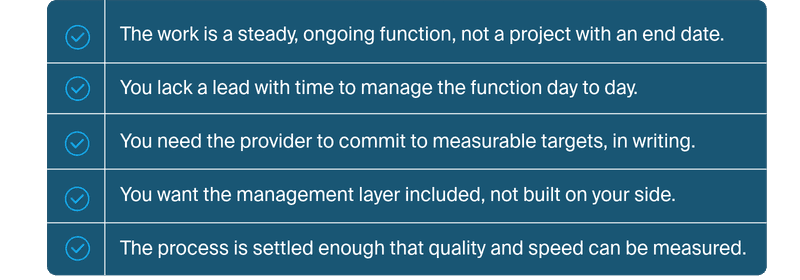
Risks and Trade-Offs of Each Model
No model is maintenance-free, and the comparison below includes what each model requires you to pay attention to and own.
In staff augmentation, the three things your team will need to own are management overhead, knowledge continuity, and dependence on your own leadership. The model concentrates responsibility on your side, so a stretched lead shows up as slower delivery, not as a provider problem. And when a team member leaves, context leaves with them.
In a managed service, the trade-offs run the other way: less day-to-day control, scope changes that carry new costs, and dependence on the provider's quality. You are buying an outcome, which means the provider's process becomes your process whether you like it or not.
What separates a good partner from a bad one is how each risk is handled. On retention, a partner with a three-year average developer tenure is managing your knowledge-continuity risk for you. On exits, transparent terms mean you are never trapped in an arrangement that stopped fitting. On fit, a clear process for replacing a mismatch, quickly and without friction, matters more than a low fit rate ever will. None of these risks is a reason to avoid a model. They are the questions to ask any provider (including us) before you sign.
Which Model Fits Your Team?
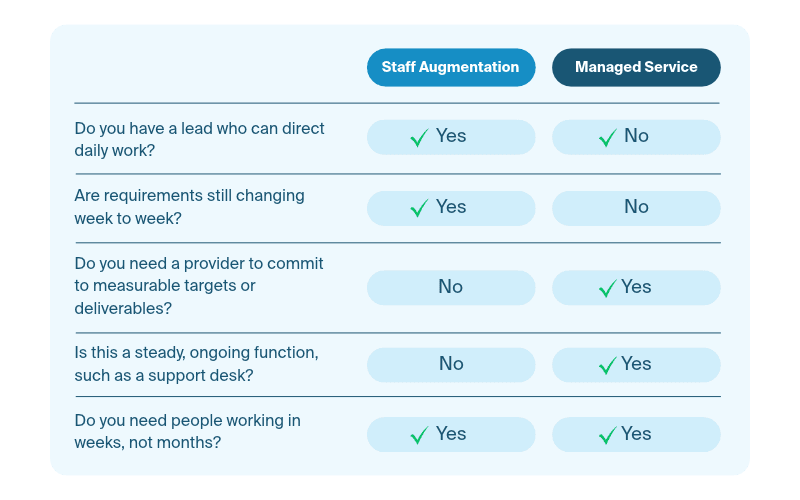
Answer five questions and the model tends to pick itself.
- Do you have a lead who can direct daily work? A yes points toward staff augmentation; a no points toward a managed service.
- Are requirements still changing week to week? A yes means the direction needs to stay with you: staff augmentation.
- Do you need a provider to commit to measurable targets or deliverables? A yes points toward a managed service.
- Is this a steady, ongoing function, such as a support desk? A yes points toward a managed service.
- Do you need people working in weeks, not months? With the right partner, both models move in weeks, so this one usually confirms the need rather than decides which path.
The five questions are deliberately practical, because each one tests a condition the two models depend on. A lead with time to direct daily work is what staff augmentation runs on, and measurable targets are what a managed service runs on, so your answers to the first three questions usually separate the models on their own. Requirements that change week to week pull you toward keeping direction in-house with staff augmentation, since the steering itself is the work. A steady, ongoing function is the classic candidate for outcome ownership, because a function that behaves the same every month is a function that can be defined, measured, and handed over to a managed service.
Read your answers as a scorecard rather than a formula. If they lean clearly one way, that is your model. If they split evenly, that split is information too: it usually means different parts of your need are pointing in different directions. For that use case we’ve prepared the below chart: the hybrid approach.
If you are still torn after scoring yourself, the profiles below cover the situations we most often see, and one of them is probably yours.
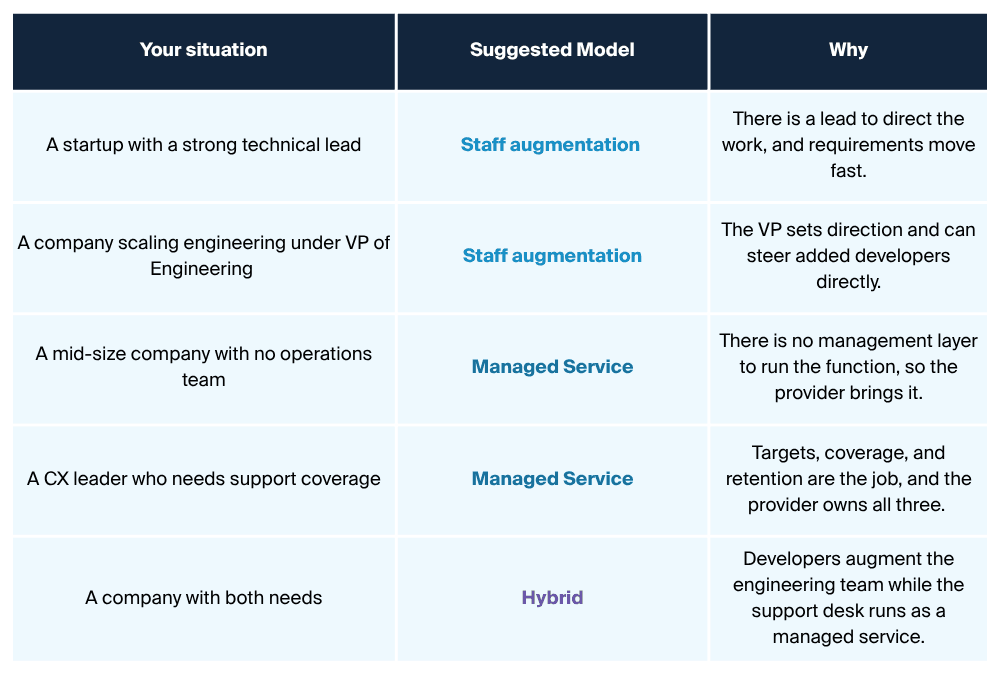
Combining Both: The Hybrid Approach
The two models are not rivals, and for many companies the right answer is both at once. A common way we see this work: two or three developers added to the engineering team through staff augmentation, while the customer support desk runs as a managed service under agreed targets. The engineering work gets steered by people who know the roadmap; the support function runs to targets without putting an operations hire on your payroll.
The one discipline the hybrid demands is explicit boundaries. Each model should have a written scope: what the added team members own, what the managed service owns, and where handoffs happen. Accountability blurs only when boundaries do. With the edges defined, hybrid can be the best of both: your team steers the processes it wants to own; when it doesn’t, they are owned externally.
Moving from one model to another
The models also convert into each other, and the conversion is common. Teams often start with staff augmentation while the requirements are still moving, then shift the stabilized work into a managed service once the process settles and the targets can be written down. If a provider can run both models, that transition happens inside the relationship instead of through a new procurement process.
That is the case for keeping tech and CX staffing under one partner. When the same partner augments your engineering team and runs your support operation, the handoffs between the two sides are internal, the standards are shared, and you are not refereeing between two vendors who have never met.
Why Nearshore Changes the Choice
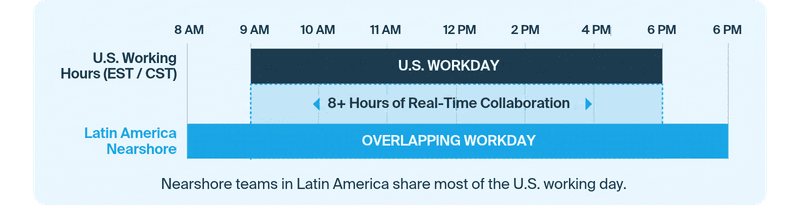
Nearshore means bilingual Latin American talent working in U.S. time zones, close enough that the working day overlaps yours almost entirely. That overlap is not a convenience. It’s what makes directing an augmented team practical: your developers are in the standup, reachable through the afternoon, and turning around tasks the same day, so you direct them the way you direct your own team.
With time zones aligned, the management model you would use in-house transfers across the border intact. The alternative, offshore, runs on overnight handoffs: work is assigned at the end of your day and reviewed at the start of the next one, which adds a delay to every exchange and makes tight direction harder to sustain.
For staff augmentation specifically, nearshore alignment is often the deciding factor, because the model only works as well as your ability to steer it daily. If you want to compare the options side by side, the onshore, offshore, and nearshore staffing models are broken down in that guide.
FAQ
Is staff augmentation a managed service?
No. Staff augmentation adds team members you direct, and you own the outcome. A managed service hands a function to a provider who owns the outcome against agreed targets. They are two different answers to the same problem: extending what your team can do.
What is an SLA, and does staff augmentation have one?
A service level agreement (SLA) is a contractual commitment to measurable targets, such as response times or quality scores. Managed services run on SLAs. Staff augmentation typically does not carry one, because the team members work under your direction and your own delivery tracking measures the results.
How quickly can I get started with each model?
Both move in weeks rather than months. Staff augmentation can start once candidates are matched to your requirements. A managed service also includes a scoping phase, where the function, targets, and process are defined before the team goes live.
How many team members can I start with?
With staff augmentation, you can start with as few as one or two developers and grow from there. Jobsity's contact center managed service teams start at five agents. Neither model requires a minimum commitment or a large team on day one.
What happens if a team member is not the right fit?
With a good partner, you raise the issue, and the partner manages the replacement: recruiting, transition, and knowledge transfer. This is one of the clearest differences between staff augmentation and hiring contractors yourself. Ask any provider, including Jobsity, to walk you through their replacement process before you sign.
Who handles HR, payroll, and equipment in each model?
The partner handles HR, payroll, contracts, and equipment in both models. The difference is management: in staff augmentation, your managers direct the work; in a managed service, the provider's managers do. Administration sits with the provider either way.
Do I keep ownership of the code and intellectual property in each model?
Yes, in both. Team members work in your systems and under your direction, and the engagement agreements assign the work product to you. A managed service agreement does the same for the function it covers. Ownership questions belong in the contract, and a reputable partner makes the answer unambiguous.
Can I switch from staff augmentation to a managed service later?
Yes, and it is a common path: teams augment while requirements are moving, then shift the stabilized work to a managed service once the process settles and targets can be defined. A partner that runs both models can manage the transition without a change of vendors.
Does either model work for customer support as well as software teams?
Both do, and the same two questions decide the fit. Support added to your existing operation, directed by your leads, is staff augmentation. A support function handed to a provider who owns the targets, retention, and management layer is a managed service. Jobsity runs both for software and support teams.
Can one partner provide both models?
Yes. Jobsity augments engineering teams with developers and runs customer support operations as a managed service, which means the two sides of your operation can share one partner, one standard, and one relationship. For many companies, that is what makes the hybrid approach practical.
Conclusion
The model follows the work. Steady, measurable functions are built for outcome ownership. Moving, shape-shifting work is built for direction.
Two questions decide it: who directs the day-to-day work, and who owns the result. Answer those and the staff augmentation vs managed services choice mostly answers itself.
You do not have to choose only one. Many teams augment their engineering teams and run their support side as a managed service, with clear boundaries between them.
Whichever way you lean, the decision is about fit and partnership. The right model with the right partner extends your team, while the wrong one just extends your invoice.
Find the Right Model with Jobsity

Tell us what you are scaling and we will recommend the model that fits, even if that means a mix. Talk to the Jobsity team about your roadmap, your support operation, or the gap between the two, and get a straight answer about which model serves it best. No pressure, no pricing surprises: just a conversation with people who have spent 14 years building teams across the Americas, roughly 500 team members strong and 100% bilingual.
Take your next step forward, schedule a meeting with us today.



Joey Rubin is a strategist, writer, and learning designer with experience in SaaS, education, and digital media. He specializes in transforming complex ideas into clear, engaging content that connects technology with people, bringing a focus on storytelling, clarity, and human-centered solutions.